It Isn't a Precedent. It's a Refusal.
The pet food press is reading the Darwin's filing as a new legal threshold. Read the six counts and it's an ordinary tool aimed at a specific behavior.
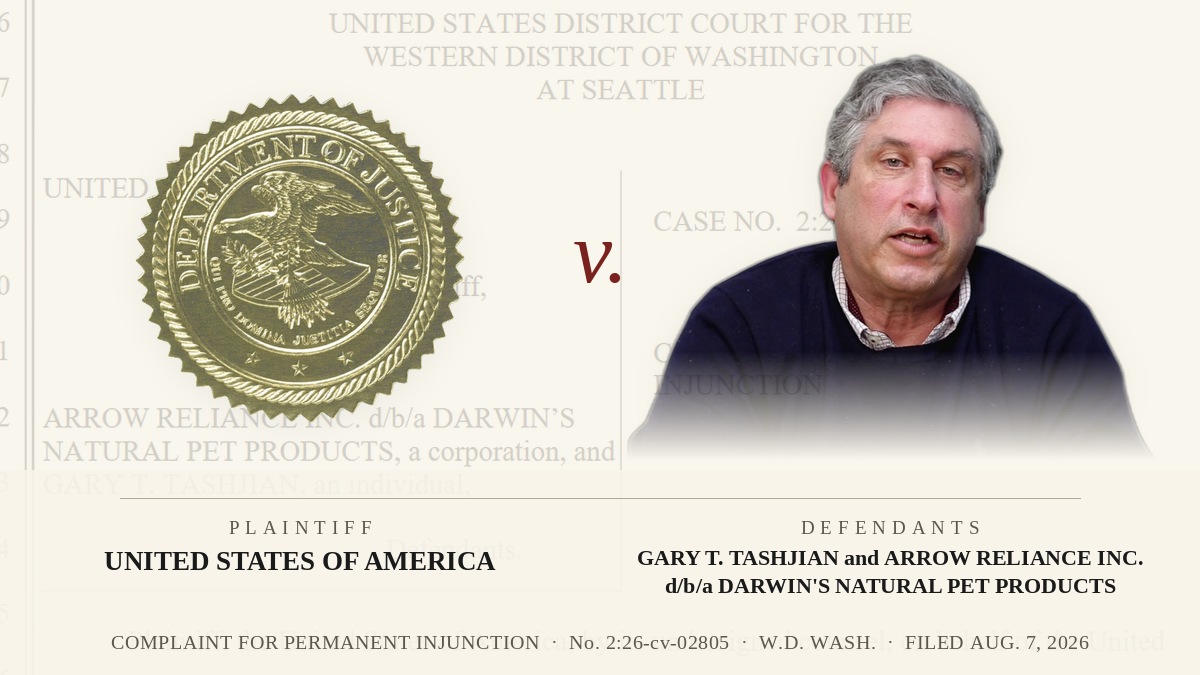
On August 7 the Justice Department filed a civil complaint in the U.S. District Court for the Western District of Washington, No. 2:26-cv-02805, against Arrow Reliance Inc., which does business as Darwin's Natural Pet Products, and against the company's owner, Gary T. Tashjian, personally. The government is asking a judge to permanently enjoin both from making and shipping pet food until they fix what FDA says is wrong. Six counts, all under the Federal Food, Drug, and Cosmetic Act.
By Tuesday the wire story had gone everywhere. Fox stations, the Washington Times, the veterinary trades. All of them working from the same DOJ release, all of them landing on the same number: of the eighteen most recent samples FDA collected, twelve carried pathogens.
Then came the frame. Truth About Pet Food, which has covered this industry longer and harder than almost anyone, called the filing a precedent that changes everything, and laid the Smucker and Sunshine Mills recall histories alongside it. If FDA will move to shut down a repeat offender, the argument goes, it now has to move on all of them. Otherwise the agency is picking favorites, and the Government Accountability Office should hear about it.
That frame is wrong in two places. Both are checkable in an afternoon.
The injunction is not new
An FDCA injunction action is the government's routine tool, not its nuclear option. The Food and Drug Law Institute describes DOJ as pursuing these cases on referral from FDA as a matter of course, usually opening with a proposed consent decree the company can sign rather than litigate.
The record backs that up. A federal court entered a consent decree of permanent injunction against Rizo Lopez Foods in 2024 after a multistate listeriosis outbreak traced to queso fresco. Fortune Food Product signed one in 2020 over sprouts. Those are two of many, in human food, over a stretch of years.
What FDA did on August 7 was reach for a tool that has been on the shelf the whole time. The novelty is that it reached for it in pet food. That is worth reporting. It is not a precedent, and calling it one obscures the more useful question, which is why this company and not another.
The counts describe a refusal
Here the equivalence argument comes apart.
The complaint does not allege that Darwin's recalled too many times. It alleges the company did not recall. Phyllis Entis at eFoodAlert, who has been documenting this manufacturer since 2016, notes the government's contention that on multiple occasions Darwin's declined to pull product after FDA or a state partner had already documented a pathogen in it.
Set that next to the histories being offered as comparisons. Smucker recalled. Sunshine Mills recalled, over and over, across aflatoxin and vitamin D and salmonella. Those recalls are what a regulatory system looks like when it is working, however late and however ugly the reason. A recall is a company doing the thing.
The rest of the counts point the same direction. The government says Darwin's identified salmonella, Listeria monocytogenes, and Shiga toxin-producing E. coli as hazards in its own plan, and then failed to put adequate preventive controls against them. FDA pulled salmonella off an environmental swab inside the Tukwila facility during a 2024 inspection. Finished product sampled between 2017 and 2025 came back positive for all three organisms.
One count has gone almost entirely unreported. The government alleges Darwin's failed to register as a food facility, which is the baseline federal obligation for anyone manufacturing, packing, or holding food. A company that told the press in 2024 it had served more than 300,000 families in twenty years.
None of this has been proven. The allegations still have to meet a preponderance-of-the-evidence standard if the case reaches trial, and Tashjian has said publicly that he disagrees with FDA's claims and intends to defend the company's ability to keep making raw food.
Paragraph 36
The complaint's thirty-sixth paragraph describes a four-year-old who developed a Shiga toxin-producing E. coli infection in August 2024 and went on to hemolytic uremic syndrome. The family dog ate Darwin's. According to FDA's advisory, whole genome sequencing matched the O157:H7 in an unopened package of Darwin's beef dog food from the family's freezer to the organism in the child's stool sample.
The child has a name, and his lawyer published it this week. Bill Marler represents Noah Ruiz and his family. Marler's account puts the hospital stay at a month.
Entis's tally of FDA's complaint file runs to 49 consumer reports between 2016 and January 2026: thirty-four sick dogs, five of them dead, and thirty-five sick cats, four dead.
The part that should worry every fresh brand
Darwin's sold by subscription only. No shelf, no distributor, no retail stock to sweep. When product needs to come back, the mechanism is an email to a customer list and a hope that people go check the freezer.
FDA said in earlier advisories on this company that it had not received sufficient documentation that affected product was out of customers' freezers. That is not a Darwin's problem. That is the structure of direct-to-consumer frozen food, and it applies to every company shipping fresh food to a doorstep, this one included.
The question the industry should be asking is not whether FDA will file the next complaint. It is what a recall means when the only inventory left is in ten thousand chest freezers.
The allegations described here come from a civil complaint and an FDA advisory. They have not been proven in court. The complaint is posted publicly by the Department of Justice.