
Rated A. Not a member.
In 1933 the all-white Southern Association graded Wiley excellent — and told it not to consider itself one of them. Membership took another twenty-seven years.
Wiley College, Marshall, Texas.
Wiley was founded in Marshall, Texas in 1873 by the Freedmen's Aid Society of the Methodist Episcopal Church. It is the oldest historically Black college west of the Mississippi River.
By the 1920s it was building like an institution that intended to last: a chapel in 1924 with a pipe organ unusual for a school its size, Dogan Hall for women in 1925, a refectory. In 1929 it dropped its high school and trade programs to concentrate on college work.
In 1930, the Southern Association of Colleges and Secondary Schools established a committee to inspect Black schools.
In 1933, Wiley became the first historically Black college in Texas to receive an "A" rating from that association. It was the first time a Black school anywhere had been evaluated by the same agency, against the same standards, as white colleges.
And the association made clear that Wiley should not consider itself a member.
What that means
Read the two halves together, because the meaning is in the gap between them.
The judgment was: by our own standards, applied by our own inspectors, this school is excellent.
The membership decision was: and that changes nothing.
An accreditation body exists to answer one question — is this institution good enough. In 1933 the Southern Association answered yes about Wiley and then declined to act on its own answer.
That is not a school failing to meet a standard. That is a standard refusing to mean what it says.
Twenty-seven years
Wiley was admitted to full membership in the Southern Association in 1960.
Twenty-seven years between the grade and the membership. Nothing in the record suggests the college got meaningfully better in the interval. It had already been rated A.
What changed in twenty-seven years was not Wiley.
What it did while it waited
The years after the rating are not a story of an institution in a holding pattern.
Melvin B. Tolson taught English and speech at Wiley, coached football, directed plays, and ran the debate team, while building a body of work that made him one of the significant American poets of the century.
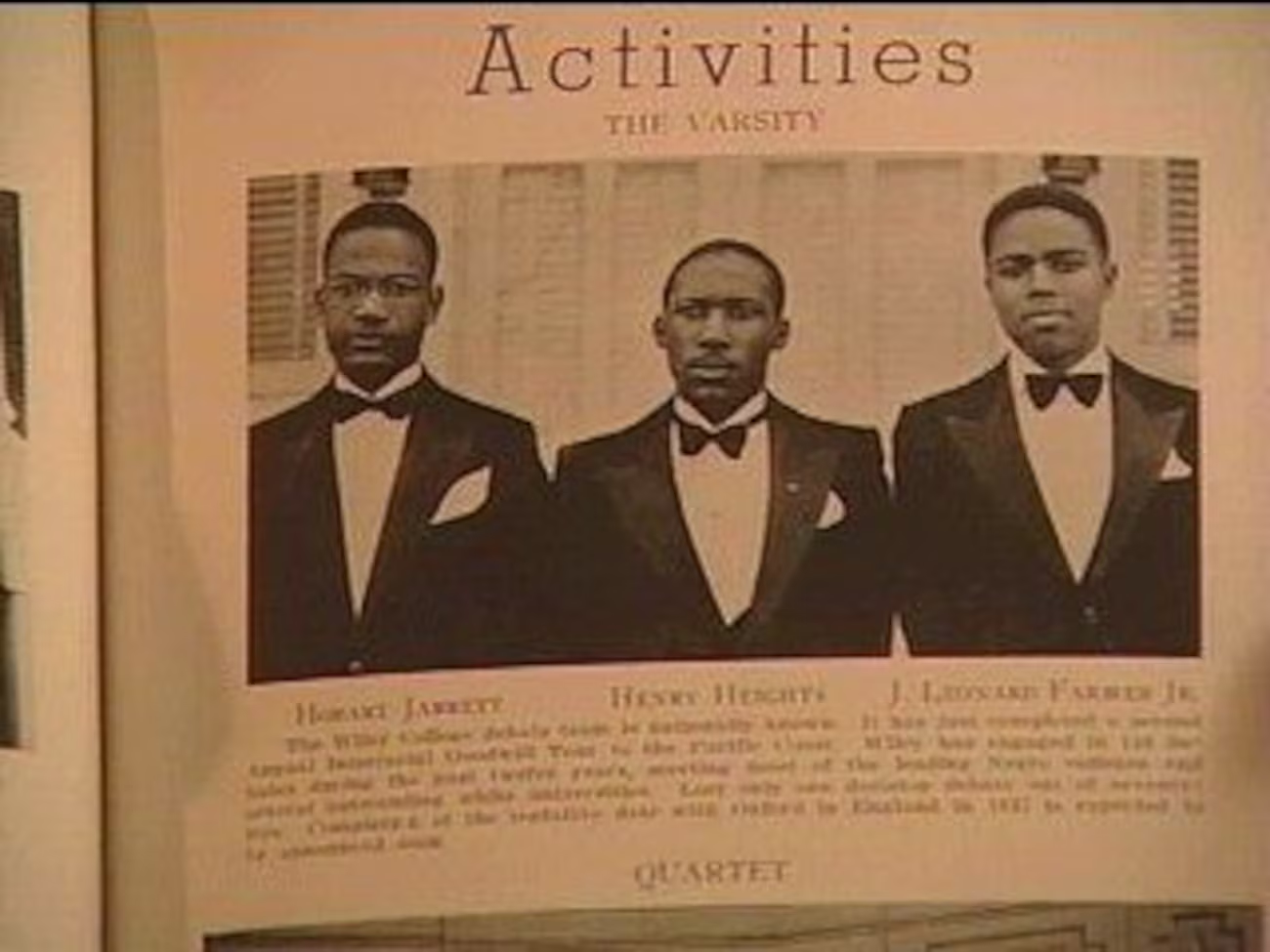
His debate team beat essentially every Black college it faced. In 1932 — a year before the A rating — it became the first Black college team to debate a white college, and it won, against Oklahoma City College. In 1935 it defeated that year's national champions, the University of Southern California.
In 1936, Wiley helped found the Southwestern Athletic Conference. In 1944 it became a founding member of the United Negro College Fund.
It was doing all of that as an institution the region's own accreditor had graded excellent and refused to seat.
The name
In 1929 the school changed its name from Wiley University to Wiley College, to signal that it was concentrating on undergraduate work.
In November 2023 — ninety-four years later — it changed back to Wiley University, alongside the launch of its first master's programs.
The paperwork took most of a century. The institution was always the thing it said it was.
Sources: Texas State Historical Association, Handbook of Texas, "Wiley College" · Wiley University Academic Catalog 2024–2027, institutional history · Marshall News Messenger, "Wiley College Reached 150 Years" · Association of Colleges and Secondary Schools for Negroes, institutional records.
Corrections and additions: whnn@willieherman.com
← All WHNN stories